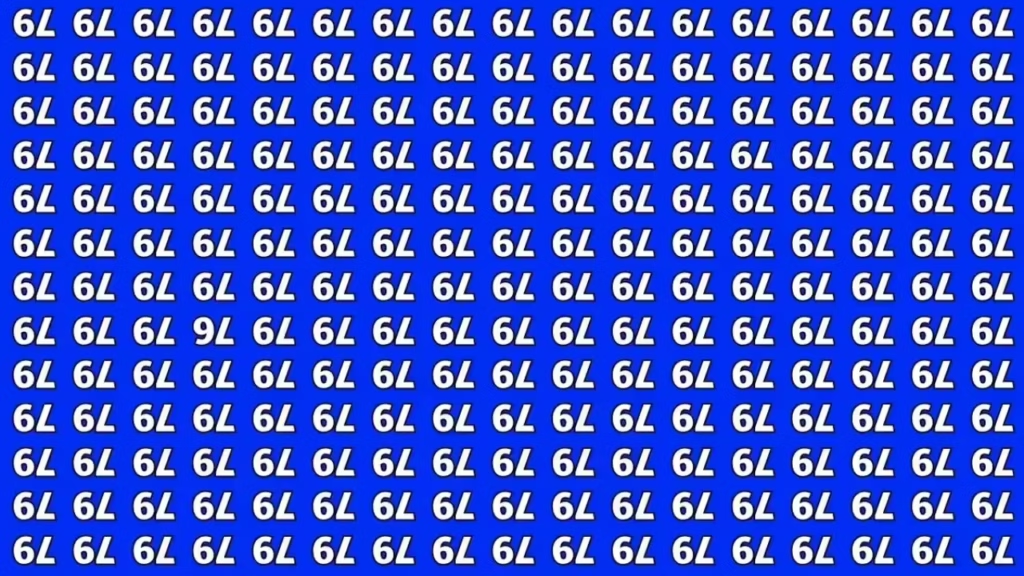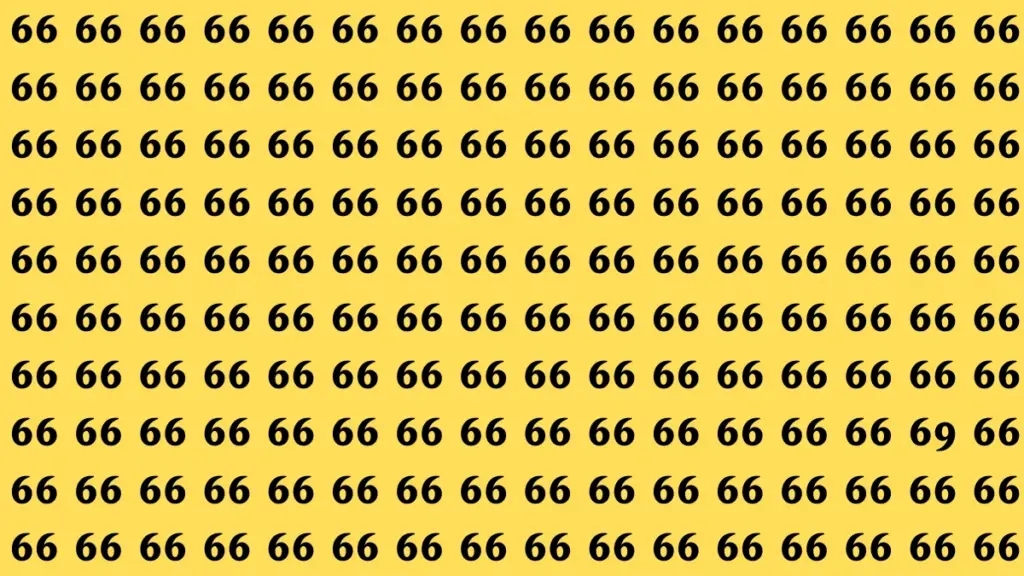
At first glance, everything seems identical. Your brain relaxes, assuming there’s no trick. That’s exactly when the puzzle tricks you.
The Hidden Challenge: Spot the 69
In this mind-bending test, a grid is filled with the number 66 repeatedly. Somewhere in that sea of identical numbers, a 69 is hiding. Sounds easy, right? But once the clock starts, even the sharpest eyes start doubting themselves.
This isn’t just an eyesight test—it’s about patience, pattern recognition, and how fast your brain can override autopilot thinking.

Why Number Illusions Fool Your Brain
Our brains are wired to spot patterns. When you see rows of 66s, your mind shortcuts, deciding everything is the same. That saves time in daily life, but in puzzles like this, it becomes your weakness.
Instead of reading each number carefully, your brain scans in chunks, processing the grid as a whole. The 69 blends in because it looks almost identical. The flipped 9 is a tiny difference, yet in a tight grid, it’s hard to notice.
This is called perceptual grouping. Once your brain locks onto a dominant pattern, small inconsistencies are ignored.
The 10-Second Test
Ready to challenge yourself?
Picture a grid filled with dozens of 66s. One 69 is hiding somewhere. Set a 10-second timer and start scanning.
Most people scan left to right, row by row—but that method can slow you down. Your eyes get stuck reading rather than searching.
If you don’t find it on the first try, don’t worry. Many need a second attempt.
Tips to Spot the Hidden 69 Faster
- Change scanning direction: Try vertical or diagonal scanning. Breaking your usual reading habit resets your brain.
- Focus on the tail: Ignore the first 6 and examine the bottom curve. The 9 has a distinct tail compared to the 6.
- Step back: Looking too closely can strengthen the pattern in your mind. Relax your focus and the 69 might pop out faster.
- Divide the grid: Split the image into quadrants and scan each section carefully to reduce overwhelm.
These techniques sharpen observation skills beyond just this puzzle.
What This Illusion Reveals About Attention Skills
If you found the 69 in 5–10 seconds, your visual discrimination is strong. You notice micro-details and shift focus quickly.
If it took longer, it doesn’t mean weak observation. Your brain favors pattern efficiency over detail precision—a useful trait in daily life.
Optical illusions like this highlight the shortcuts our brains take, showing how repetition and similarity influence perception.
Why These Illusions Are So Addictive
Puzzles like “Find 69 Among 66” go viral because they are:
- Quick to attempt
- Simple to understand
- Surprisingly challenging
- Competitive and shareable
They exercise the brain rapidly without feeling like work. Spotting the hidden number provides a satisfying reward, encouraging repeated attempts.
The Hidden 69 Revealed
If you still missed it, the 69 is usually off-center or tucked in a corner. Once spotted, you’ll wonder how you overlooked it. That’s the magic of optical illusions—they make the obvious seem invisible.
Try again—you’ll likely find it faster the second time.
FAQ
What makes this optical illusion challenging?
Repetition tricks the brain into seeing one pattern rather than individual numbers, making subtle differences harder to detect.
How long should it take to find the hidden 69?
Most people need 10–30 seconds. Detail-focused individuals may spot it in under 5 seconds.
Do optical illusions improve brain function?
Yes, regular practice strengthens attention, visual discrimination, and pattern recognition.
Why does 69 resemble 66 at a glance?
Both share similar shapes. Close placement in the same font and spacing causes the 9 to blend in with the 6s.
Can kids try this puzzle?
Absolutely. Number-based optical illusions are safe, fun, and help develop focus and quick thinking skills for all ages.